A slope that looked manageable when you bought the house has a way of becoming urgent the first time heavy rain sends soil toward your patio. If you’re pricing a retaining wall in San Diego right now, you already know the terrain here isn’t forgiving — and neither are the permit thresholds or the quotes you’ve been getting.
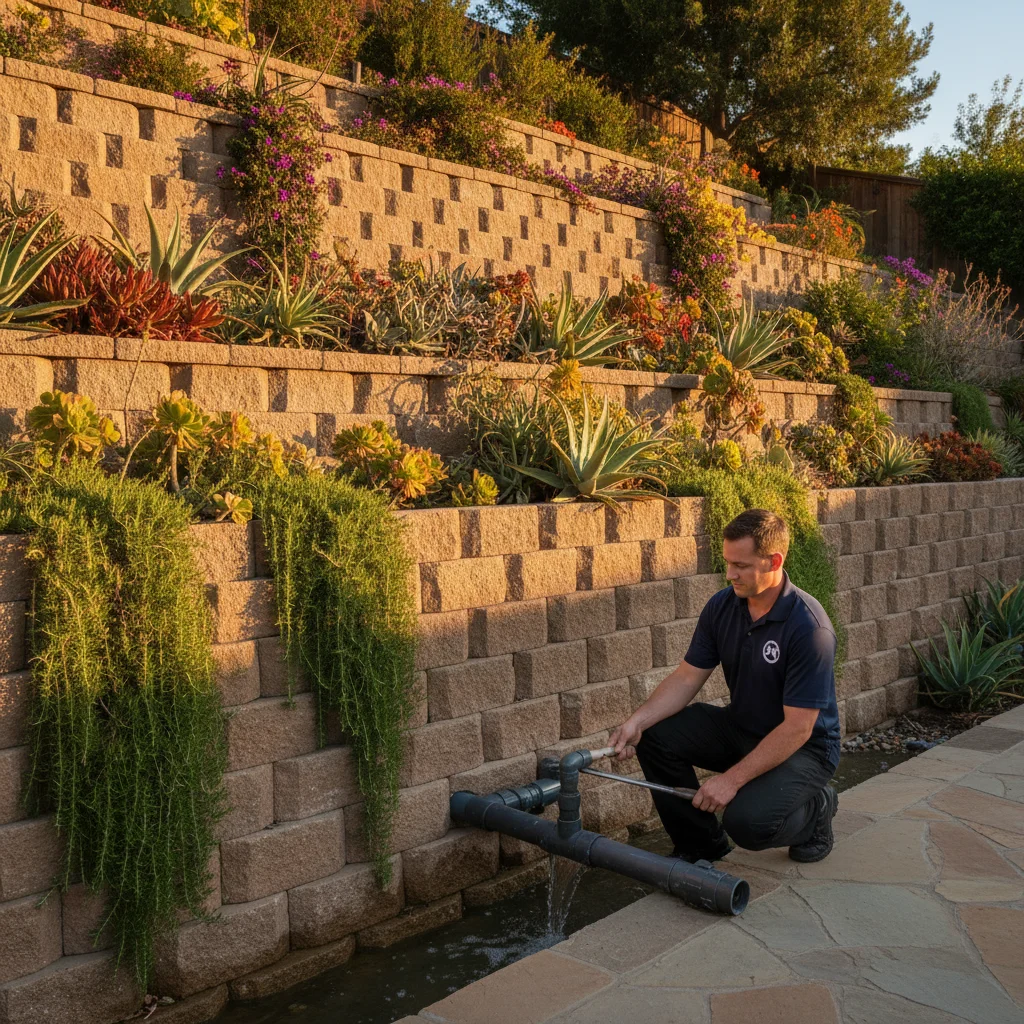
Why SD’s hillside lots drive up retaining wall cost
San Diego’s geography is the main reason retaining wall jobs here run higher than national averages. A lot in Mission Hills, Tierrasanta, or anywhere in the east county foothills can sit on decomposed granite, expansive clay, or a mix of both — sometimes within the same cut. Soil type matters enormously. Expansive clay swells when wet and pushes against a wall with surprising force. DG is easier to cut but drains fast, which creates its own erosion pressure.
Add steep lot grades — many San Diego hillside properties have natural slopes between 2:1 and 3:1 — and you quickly need more material, deeper footings, and in many cases a licensed engineer before you can pull a permit.
Labor rates reflect the region, too. San Diego’s construction labor market is tight. Expect to pay more per hour here than in the Central Valley or the Inland Empire. A job that might run $18,000 in Sacramento can easily hit $26,000 in Encinitas, not because someone is padding the quote but because the inputs genuinely cost more.
Coastal proximity adds one more layer. Salt air accelerates corrosion on rebar and hardware. A contractor building a wall in Solana Beach should be using epoxy-coated rebar or stainless fasteners — and the good ones do.
Material pricing: CMU, segmental block, poured concrete, natural stone
Material choice drives the single biggest line item in any retaining wall estimate. Here’s a straightforward breakdown of what you’re looking at in San Diego right now.
Concrete masonry unit (CMU)
CMU block — standard gray cinder block — is the workhorse of commercial and residential retaining walls. It’s strong, relatively fast to lay, and takes stucco or paint well. Installed cost in San Diego typically runs $35–$55 per square face foot, depending on wall height and site access. A 3-foot-tall wall stretching 40 linear feet is 120 square face feet, so budget $4,200–$6,600 for the wall itself before drainage and permits.
Segmental retaining wall block (Allan Block, Versa-Lok, similar)
Segmental block is the most common choice for residential hillside walls in San Diego. The interlocking units are engineered for batter (backward lean) and pair with geogrid for taller applications. Installed costs run $40–$65 per square face foot. The aesthetic range is wide — you can match travertine-look block to a Spanish Colonial home or go clean and modern with a split-face finish.
Poured concrete
Poured concrete walls (cast-in-place) are structurally excellent and mandatory on some engineer-specified jobs. They’re also expensive. Expect $60–$85 per square face foot installed. Forming, pouring, and stripping a 4-foot wall takes a full crew and a pump truck on most San Diego lots. The upside: a well-built concrete wall can last 50+ years with minimal maintenance.
Natural stone
Dry-stack or mortared natural stone is the premium option, both in cost and aesthetics. Installed prices in San Diego range from $75–$120 per square face foot depending on stone type, transport, and the skill required to fit irregular pieces. Baja stone and local decomposed granite cap are popular regional choices. Natural stone walls are rarely cost-effective purely on a structural basis, but on a high-value property they add landscape design appeal that other materials can’t replicate.
Engineering and permit thresholds (the 4-foot rule)
This is where a lot of homeowners get surprised. San Diego County’s grading ordinance — along with most incorporated city codes within the county — triggers a building permit for any retaining wall over 4 feet in height, measured from the bottom of the footing to the top of the wall. That “bottom of footing” language matters. A wall with a 12-inch footing that appears 3 feet above grade is actually 4 feet total. It needs a permit.
Permit fees in San Diego County unincorporated areas typically run $500–$1,500 for a standard residential retaining wall, though complex graded-lot projects can push higher. City of San Diego fees follow a similar range. Factor 3–6 weeks for plan check on a simple wall; engineered walls or walls within a geologic hazard zone can take longer.
An engineered wall — one requiring a licensed structural or geotechnical engineer to stamp the plans — adds $1,500–$4,000 to the project cost depending on complexity. Walls over 6 feet, walls on slopes greater than 3:1, or walls within 15 feet of a property line or existing structure almost always require engineering.
Before hiring anyone, verify their license through the CSLB license check. A retaining wall contractor in California should hold a C-29 (masonry) or B (general building) license at minimum.
Drainage, geogrid, and what gets hidden in the quote
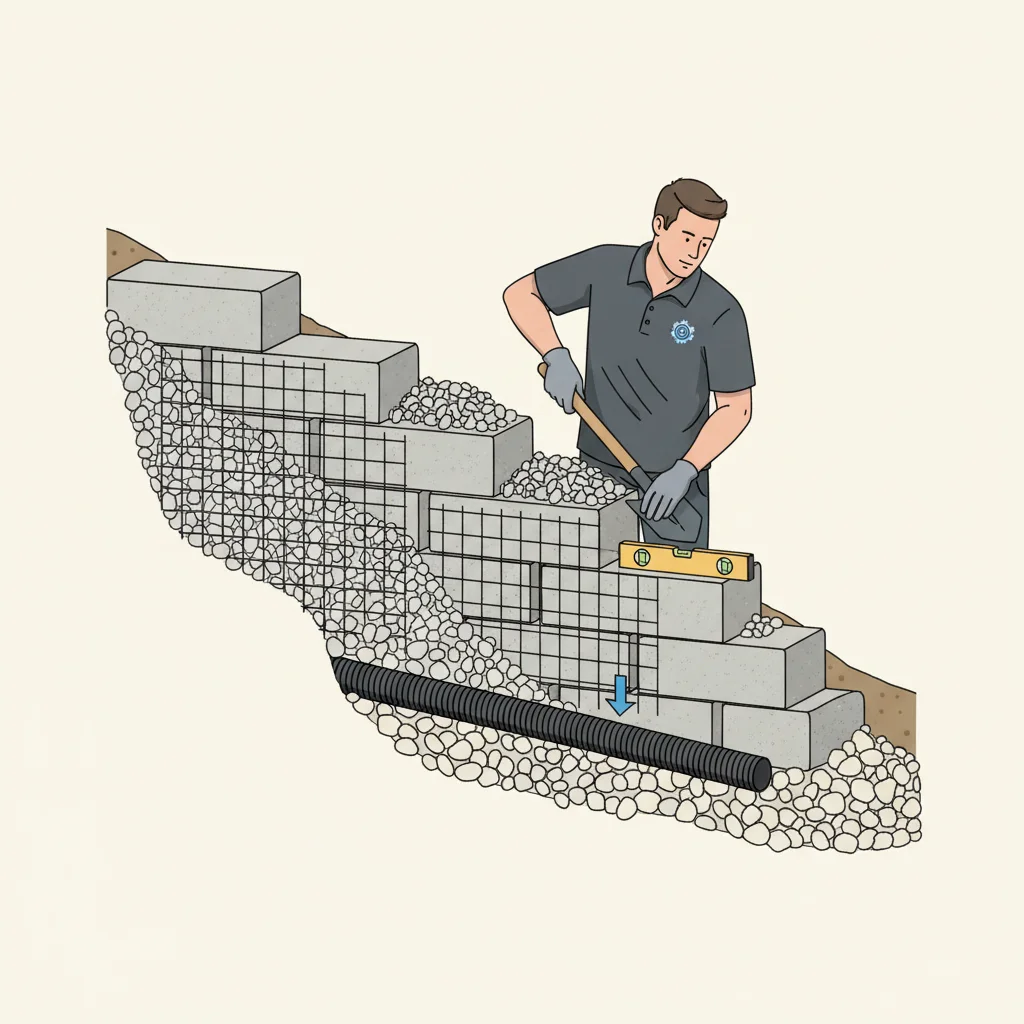
The face of the wall is what you see. The drainage system is what makes the wall last. Hydrostatic pressure — water building up in saturated soil behind a wall — is the number one cause of retaining wall failure in San Diego. After a wet winter like 2023’s, we saw walls across the county fail that were less than five years old, almost always because drainage was cut short.
A properly built wall behind a San Diego hillside includes:
- Perforated drain pipe at the base of the wall, sloped to daylight or a catch basin
- Class II permeable gravel backfill (or drain rock) directly behind the wall face, minimum 12 inches wide
- Filter fabric between the gravel and native soil to prevent migration
- Weep holes or gaps in the wall face as a backup pressure release
Geogrid — a woven or welded polymer grid buried in horizontal layers behind the wall — is required on segmental walls above roughly 3.5 feet. It ties the retained soil mass into the wall system and dramatically increases the wall’s ability to resist overturning. Each geogrid layer adds material and labor cost, typically $3–$6 per square foot of wall face when amortized across the project.
Watch out for quotes that list only “wall installation” without specifying drainage pipe size, backfill material, or geogrid layers. That’s where low-bid projects go wrong. A complete retaining wall scope should itemize every one of those components.
Tiered walls vs one tall wall: cost and code tradeoffs
A single 8-foot retaining wall sounds straightforward. In practice, it’s expensive, heavily engineered, and often unnecessary. Most residential hillside lots in San Diego are better served by two or three tiered walls of 3–4 feet each, with planting terraces between them.
Here’s why the math often works in favor of tiers:
Code: A 4-foot wall may or may not require a permit depending on footing depth. Drop each wall to 3.5 feet above grade with a footing that keeps total height under 4 feet, and you may avoid the permit trigger entirely on a simpler project. Your contractor should confirm this with the local jurisdiction — it varies between the City of San Diego, Chula Vista, El Cajon, and unincorporated county areas.
Engineering: A single 8-foot wall almost always needs a structural engineer stamp. Three 3-foot walls may not. That’s $2,000–$4,000 in engineering fees potentially off the table.
Material load: An 8-foot wall needs a substantially larger footing and more geogrid depth than a 4-foot wall. The material savings on three smaller walls often offset the labor of building three separate structures.
Planting opportunity: The terraces between tiered walls give you planting pockets — ideal for drought-tolerant landscaping that stabilizes the soil between walls and reduces long-term erosion pressure. That’s practical, not decorative.
The tradeoff is horizontal space. Stepping back 3–5 feet per tier eats into your usable yard. On a narrow lot, one taller engineered wall may actually be the right call.
Real project ranges from coastal, inland, and east county jobs
These are realistic project ranges based on work done in San Diego County. They’re not guarantees, but they give you a calibrated starting point.
Coastal (Encinitas, Del Mar, Solana Beach) A 40-linear-foot segmental block wall, 4 feet tall, with full drainage system, corrosion-resistant hardware, and permit: $18,000–$26,000. Salt air protection and tight site access (common in these neighborhoods) push the range up.
Central San Diego (Mission Hills, North Park, Tierrasanta) Two-tier CMU wall system totaling 60 linear feet, each tier 3.5 feet tall, drainage, no engineering required: $22,000–$32,000. Older lots with concrete driveways and mature trees complicate access and add cost.
Inland (Santee, El Cajon, Lakeside) Single segmental block wall, 50 linear feet, 5 feet tall, engineered, full drainage: $24,000–$36,000. Expansive clay soils in this corridor drive up engineering requirements and backfill volume.
East county / rural (Alpine, Ramona, Jamul) Natural stone or CMU on steep terrain, 80+ linear feet, engineered, grading permit plus building permit: $35,000–$60,000+. Remote access, hauling costs, and complex grading requirements all compound here.
Every project is unique. Soil reports, existing drainage infrastructure, HOA requirements, and proximity to property lines all shift the final number. Get at least three itemized bids, not ballpark figures over the phone.
Our retaining walls and hardscaping service covers the full scope — design, engineering coordination, permit pulling, construction, and drainage — so nothing falls through the cracks between subcontractors.
When to call us
Retaining wall work on a hillside lot in San Diego isn’t a weekend DIY project. The permit exposure, the soil variability, and the drainage requirements all call for a licensed contractor who knows what San Diego County inspectors are looking for. If you’ve got a slope that’s moving, a wall that’s leaning, or a new lot you’re trying to make usable, we can walk the site and give you a straight answer on scope and budget. Call us at (858) 925-5546 for a same-day estimate.