Most aeration advice you’ll find online was written for the Midwest or the Southeast. If you follow that calendar in San Diego, you’ll aerate at the wrong time and wonder why your lawn never recovered.
Why SD’s aeration window doesn’t match the rest of the country
The national guidance — aerate in fall for cool-season grass, aerate in late spring for warm-season grass — is roughly correct. But San Diego’s Mediterranean climate compresses and shifts those windows in ways that trip up a lot of homeowners.
We don’t get the hard freezes that slow warm-season grasses to dormancy in January. We rarely see the prolonged cool springs that give fescue a long recovery runway in the Pacific Northwest. What we do get is a dry season that runs roughly May through October, marine layer that keeps coastal lawns cooler than inland ones, and soil that’s often either dense clay (think Clairemont, Chula Vista, parts of El Cajon) or compacted decomposed granite (DG) in hillside neighborhoods like Rancho Peñasquitos or Jamul.
Both clay and DG compact hard. Clay binds together under foot traffic and irrigation, blocking oxygen from reaching roots. DG packs like concrete when it dries out. Either way, water beads off the surface instead of soaking in, your grass thins, and no amount of fertilizer fully compensates.
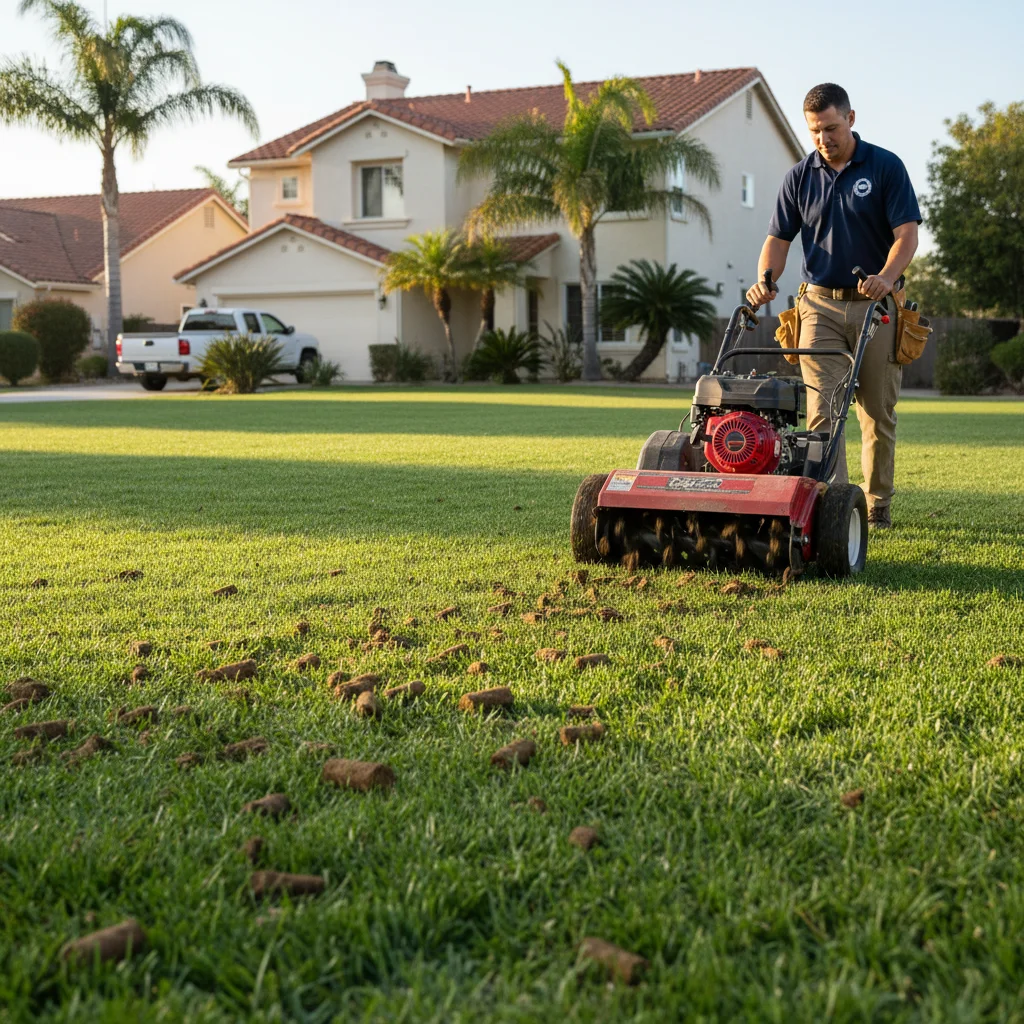
Aeration breaks that cycle. It pulls finger-sized soil cores out of the ground every few inches, opening channels for water, air, and nutrients to reach the root zone. But those channels only help if the grass can actively grow to fill them. Aerate at the wrong time and you’ve stressed a lawn that can’t recover before heat or drought arrive.
The good news: once you know your grass type, the window in San Diego is predictable.
Cool-season fescue: the September-October sweet spot
Tall fescue is the most common lawn grass in inland San Diego — neighborhoods like Santee, La Mesa, Escondido, and most of North County. It grows actively in fall and spring, goes semi-dormant in summer heat, and tolerates our dry conditions better than Kentucky bluegrass.
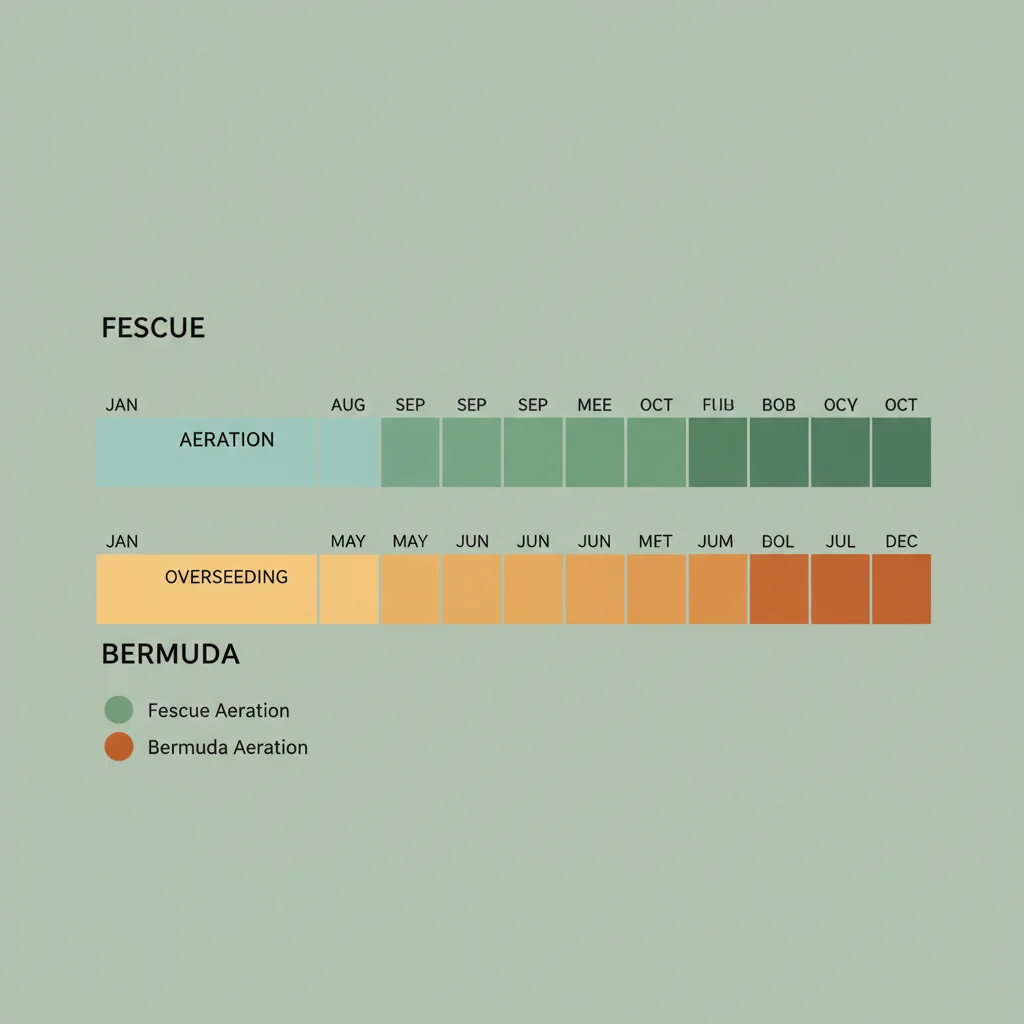
For fescue, aerate between mid-September and mid-October. Here’s why that window works:
- Soil temperatures are dropping from summer highs but still above 50°F, which is the floor for seed germination
- The worst heat stress is over, so a freshly aerated lawn isn’t fighting 90°F days inland
- You have 8-10 weeks of moderate weather before winter slows growth
Pair aeration with overseeding in the same visit. Spread tall fescue seed immediately after aeration — the open cores act as perfect seed beds. UC Master Gardeners of San Diego County recommend this fall timing specifically because it aligns seed germination with the cool, moist months ahead.
Water daily for the first two weeks after overseeding, then taper to three times a week once seedlings hit about an inch tall. Follow the City of San Diego’s watering schedule guidelines if you’re on city water — they have tiered restrictions that apply year-round.
Avoid aerating fescue in spring. Yes, fescue grows in spring, but you’re also heading into summer heat. A stressed lawn opening in March or April doesn’t have enough recovery time before July. Spring is better used for a fertilizer application — our lawn fertilization service is timed to exactly this window.
Warm-season bermuda and kikuyu: the May-June window
Bermuda and kikuyu are the workhorses of coastal and lower-elevation San Diego yards. You’ll find bermuda all over Mission Valley, Coronado, Ocean Beach, and Chula Vista. Kikuyu is common in older neighborhoods — it spreads aggressively and survives drought better than most homeowners expect.
Both are warm-season grasses. They go dormant (or near-dormant) in winter and green up fast once soil temperatures climb above 65°F. That typically happens in San Diego from late April into May, depending on how close you are to the coast.
Aerate warm-season grasses in May or June — after active growth resumes but before peak summer heat locks in. Aerating in April when the soil is still cool means slow recovery. Aerating in August means you’re opening a heat-stressed lawn to more stress.
Overseeding bermuda in summer is usually unnecessary unless you have significant thin or bare patches. Kikuyu fills in so aggressively that overseeding is almost never needed — aeration alone opens the canopy and lets it thicken. If you do want to overseed bermuda for coverage, use hulled bermudagrass seed right after aeration in May, water frequently, and keep off the lawn for two to three weeks.
One note on kikuyu: because it spreads by both stolons and rhizomes, aeration can occasionally drag runners into new areas. That’s not a problem if you want dense coverage, but worth knowing if you’re trying to contain it to a specific zone.
Core aeration vs liquid aeration: what works in our soil
You’ll see liquid aeration products at Home Depot — concentrated solutions of humic acid or soil conditioners marketed as a no-mess alternative to machine aeration. They’re worth understanding honestly.
Core aeration uses a machine to physically pull 2-3 inch soil plugs every 3-4 inches across the lawn. It’s mechanical, proven, and visibly effective. You can see the plugs on the surface and the holes in the soil. For San Diego’s compacted clay or DG, this is the right choice. Nothing breaks apart a dense soil profile like physically removing material from it.
Liquid aeration improves water penetration in mildly compacted soils and can be a useful supplement. But it doesn’t replace core aeration in heavy clay or packed DG. The chemistry helps water move through pore spaces — it can’t create pore spaces that don’t exist.
Our recommendation: if your soil passes the screwdriver test (you can push a standard screwdriver 6 inches into moist soil with one hand), liquid aeration may be a reasonable maintenance step between core aeration years. If you need two hands and elbow grease to get 2 inches down, core aeration is what you need.
Core aeration machines weigh 300-400 pounds and require a truck or trailer to transport. They’re available at equipment rental yards in San Diego, but handling them on slopes or in tight backyard gates is genuinely difficult and can cause property damage if the operator isn’t experienced.
Overseeding cost and what to expect after
San Diego overseeding costs vary based on lawn size, grass type, and whether it’s bundled with aeration. Ballpark figures for the San Diego market:
- Core aeration only: $75-$150 for lawns under 1,000 sq ft; $150-$300 for 2,000-3,000 sq ft
- Overseeding (seed + labor): add $50-$120 depending on seed type and coverage rate
- Bundle discount when done together: typically 10-15% off vs. separate visits
Tall fescue seed runs around $2-$4 per pound at retail. A standard overseeding rate is 5-8 lbs per 1,000 sq ft for overseeding an existing lawn (higher for bare patches). Bermudagrass hulled seed is slightly more expensive per pound but you need less of it.
After aeration and overseeding, expect the lawn to look rough for about a week — soil cores on the surface, loose seed visible. That’s normal. Cores break down within 2-3 weeks with regular watering. New germination on fescue typically shows in 10-14 days. Don’t mow until new seedlings reach 3 inches.
Your existing lawn maintenance schedule should pause for the first two weeks post-overseeding — no heavy equipment on the new seed, and hold off on herbicides for at least 6-8 weeks since most pre-emergents will kill germinating grass seed along with weeds.
DIY vs hiring out: where the line actually is
Core aeration on a flat, open lawn under 1,500 square feet is genuinely DIY-friendly. Rent the machine, walk it in a grid pattern, pick up the cores or leave them to decompose, overseed the same day. Budget about half a day and $60-$80 for equipment rental.
The math changes in a few situations:
Slopes. A 300-pound aerator on a sloped San Diego hillside yard is a safety issue. The machine can kick sideways on grade. If your yard has anything steeper than a gentle pitch, hire it out.
Access. Most rental aerators won’t fit through a standard 36-inch side gate. If your backyard is only accessible through the house or a narrow gap, a professional crew with a compact machine is worth the cost.
Large lawns. Above 2,500 square feet, a rental aerator makes three or four passes and takes three to four hours. A professional crew with commercial equipment covers the same area in under an hour and seeds in the same visit.
Timing pressure. The fall fescue window in San Diego is narrow — roughly six weeks. If you’re not sure you can rent equipment, move seed, and execute before November, the cost of hiring out is cheap insurance against missing the window for a full year.
For anything in between, check that any contractor you hire holds a current California contractor’s license. You can verify a CSLB license here in about 30 seconds.
When to call us
If your lawn is on a slope, your yard has restricted access, or you’re past the midpoint of your grass type’s ideal window and don’t want to lose another season, it’s time to bring in a pro. We handle core aeration and overseeding across San Diego County, timed specifically to your grass type and microclimate. Call us at (858) 925-5546 for a same-day estimate.