Even in a perfect San Diego landscape, weeds are an inevitable challenge for any homeowner. Identifying them correctly is the first step toward effective removal and keeping your lawn lush and healthy. Misidentification can lead to wasted effort, ineffective treatments, and continued frustration.
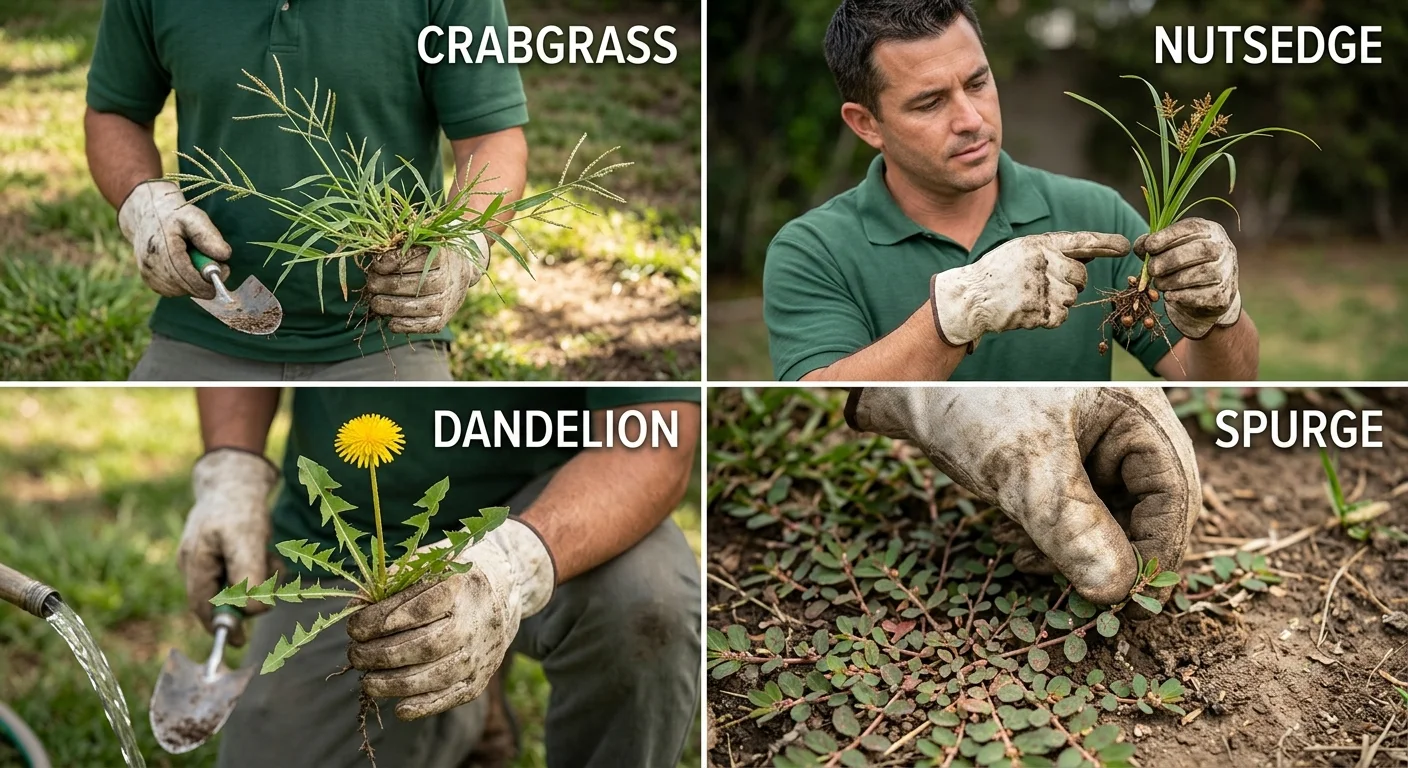
This guide will help you pinpoint the most common weeds you’ll encounter in San Diego lawns. We’ll show you what they look like, how they grow, and the best ways to get rid of them. Understanding your enemy is crucial for successful weed control, especially when you’re dealing with the specific challenges of our local environment.
Identifying crabgrass and how it spreads in summer
Crabgrass (Digitaria spp.) is one of San Diego’s most notorious lawn invaders, especially as summer temperatures rise. It’s an annual weed, meaning it completes its life cycle within one growing season, but it produces thousands of seeds that lie dormant and sprout the following year. This opportunistic weed thrives in thin, stressed, or improperly watered lawns, making it a common sight after a dry spell or if your turf isn’t getting adequate care.

What it looks like: Crabgrass has broad, coarse leaves that sprout from a central clump, growing low to the ground in a crab-like fashion (hence the name). Its leaves are typically light green and can have a slightly hairy texture. As it matures, it sends out finger-like seed heads that are easily visible and can produce a staggering number of seeds. These seeds are a primary reason for its rapid spread.
Where it grows: You’ll often find crabgrass emerging in sunny, open areas where your lawn might be weak or patchy. It loves compacted soil and areas with poor drainage, often taking advantage of bare spots created by drought stress or heavy foot traffic. The warm San Diego summers are ideal for its germination and growth.
How it spreads: Crabgrass spreads almost exclusively by seed. Each plant can produce up to 150,000 seeds, which remain viable in the soil for years. When soil temperatures consistently reach 55-60°F, usually around late spring to early summer in San Diego, these seeds begin to germinate. The plants then grow vigorously throughout the summer, producing more seeds until the first hard frost kills them off. The cycle then repeats with the new seeds the next year. Preventing crabgrass involves both pre-emergent strategies, which we discuss in our post on San Diego weed control pre-emergent timing, and post-emergent treatments once it has sprouted.
Spotting nutsedge (nutgrass) by its triangular stems
Nutsedge, often mistaken for a common grass, is actually a distinct type of weed that can be particularly stubborn in San Diego lawns. Also known as nutgrass, it’s not a true grass but a sedge, identifiable by unique characteristics that set it apart from your desired turf. This persistent perennial weed loves moist soil and can quickly take over areas with poor drainage or overwatering.

What it looks like: The key to identifying nutsedge lies in its stem. Unlike grass, which has round or flat stems, nutsedge stems are distinctly triangular when you roll them between your fingers. Its leaves are thicker, stiffer, and more upright than most lawn grasses, typically a lighter green or yellowish-green. They grow rapidly, often standing taller than the surrounding turf just a few days after mowing. Nutsedge also produces small, brownish or yellowish flower/seed heads in clusters at the top of the stem.
Where it grows: Nutsedge thrives in moist, poorly drained areas of your lawn. If you have a leaky sprinkler head, a low spot that collects water, or areas prone to overwatering, you’ll likely find nutsedge establishing itself there. However, once established, it’s incredibly resilient and can tolerate drier conditions. It spreads aggressively through underground tubers called “nutlets” or rhizomes, making it difficult to eradicate completely.
How to differentiate it from grass: Beyond the triangular stem, observe its growth habit. Nutsedge often grows in clumps or patches, appearing much faster and taller than the surrounding grass, even shortly after mowing. Its texture is coarser, and its color is usually a brighter, almost neon green. When you pull a clump, you might notice small, brown, nut-like tubers attached to the roots, which are the nutlets. These nutlets are the primary means of its survival and spread, and they can remain dormant in the soil for extended periods, making nutsedge a recurring problem if not properly addressed.
Dealing with broadleaf weeds like dandelion and clover
Broadleaf weeds are a diverse group that includes some of the most recognizable lawn invaders, such as dandelions and clover. Unlike grasses and sedges, broadleaf weeds have wide, flat leaves with a network of visible veins, often growing from a central taproot or spreading along the ground. They are a common nuisance in San Diego lawns, especially in areas with thin turf or nutrient imbalances.

Dandelion (Taraxacum officinale): Everyone knows the dandelion. Its bright yellow flowers quickly turn into fluffy white seed heads that scatter hundreds of seeds with a gust of wind.
- What it looks like: Dandelions have deeply lobed, toothed leaves that grow in a basal rosette close to the ground. The flowers are bright yellow and grow on hollow stems. When mature, these turn into characteristic “puffballs.”
- Where it grows: Dandelions are adaptable and can grow almost anywhere, but they prefer full sun and disturbed soil. Their long, deep taproot makes them resilient, allowing them to draw water and nutrients from deep within the soil, often outcompeting shallower-rooted grasses.
- Removal: Manual removal is effective for young dandelions if you extract the entire taproot. If the taproot breaks, it can regrow. For larger infestations, a post-emergent broadleaf herbicide is typically required.

Clover (Trifolium repens): White clover is another common broadleaf weed often seen in San Diego lawns. While some consider it beneficial for its nitrogen-fixing properties, it can quickly take over a manicured lawn.
- What it looks like: Clover is easily recognized by its three-lobed leaves, often with a white crescent watermark. It produces small, spherical white flowers that attract bees. It spreads rapidly through stolons (above-ground runners) that root wherever they touch the soil.
- Where it grows: Clover thrives in compacted, nutrient-poor soils, particularly those lacking nitrogen, as it can produce its own. It’s often a sign that your lawn might need fertilization.
- Removal: For small patches, hand-pulling can work, but you need to remove all stolons to prevent regrowth. Broadleaf herbicides designed for clover are effective for larger infestations. Promoting a dense, healthy lawn with proper fertilization can also naturally suppress clover growth.

How to identify and control spurge in warm weather
Spurge (Euphorbia spp.) is a low-growing, mat-forming weed that is particularly problematic in San Diego during warmer weather. It’s incredibly prolific and can quickly establish itself in thin areas of your lawn, sidewalk cracks, or garden beds. Its rapid growth and ability to produce many seeds make it a persistent nuisance if not addressed promptly.

What it looks like: Spurge is characterized by its prostrate (low-growing, spreading) growth habit, forming dense mats that can smother turfgrass. Its leaves are small, oval, and often reddish or purplish in the center, especially in sunny conditions. One distinguishing feature is the milky white sap that oozes from its stems when broken. It produces tiny, inconspicuous flowers that quickly turn into seed capsules, often reddish.
Where it grows: Spurge loves heat and sunshine, making it perfectly suited for San Diego’s climate. You’ll find it thriving in compacted soil, cracks in pavement, disturbed areas, and anywhere the lawn is thin or stressed. It’s very common along walkways, driveways, and the edges of garden beds where soil is exposed. Its resilience allows it to flourish even in poor soil conditions.
How it spreads: Spurge is an annual weed that reproduces exclusively by seeds, but it’s incredibly efficient. A single plant can produce thousands of seeds throughout the growing season. These seeds can germinate quickly in warm soil, ensuring a continuous cycle of infestation. The plants grow vigorously from spring through fall, dying back only with the first frost. Its low-growing nature protects its seeds and young plants from being easily cut by mowers, further aiding its spread.
Control strategies: For small patches, hand-pulling spurge is quite effective, especially when the soil is moist. Be sure to wear gloves to avoid contact with the milky sap, which can cause skin irritation in some people. For larger infestations, pre-emergent herbicides can prevent seeds from germinating in spring, while post-emergent broadleaf weed killers can control existing plants. Maintaining a dense, healthy lawn through proper watering, fertilization, and mowing is also crucial, as a thick turf canopy can shade out spurge seeds and prevent them from sprouting.
When to pull vs. when to use post-emergent treatment
Deciding between manual removal (pulling) and chemical treatment depends on several factors: the type of weed, the size of the infestation, and your personal preferences. Both methods have their place in effective weed control for San Diego lawns.
When to pull weeds:
- Young, sparse weeds: If you catch weeds early, when they’re small and haven’t deeply rooted or produced many seeds, pulling them by hand is an excellent option. This is especially true for weeds with taproots like dandelions, where you can remove the entire root structure.
- Environmentally conscious: Pulling is the most eco-friendly method, as it doesn’t introduce chemicals into your environment.
- Small areas: For weeds in garden beds or isolated patches in your lawn, manual removal is manageable and precise.
- Specific weed types: Some weeds, like young crabgrass or spurge, are relatively easy to pull before they get established.
When to use post-emergent treatment:
- Widespread infestations: If your lawn is overrun with weeds like nutsedge or broadleaf varieties, pulling every single one can be overwhelming and impractical. Post-emergent herbicides are designed to kill weeds that have already emerged from the soil.
- Persistent weeds: For stubborn perennial weeds like nutsedge with its underground tubers, pulling alone often isn’t enough. Specialized post-emergent products are necessary to target these weeds systemically.
- Time constraints: If you don’t have the time for extensive manual labor, a targeted post-emergent application can save you hours.
- Pre-emergent failures: If weeds have slipped past your pre-emergent application (which prevents germination), a post-emergent is your next line of defense.
It’s important to remember that for severe infestations or complex weed problems, a professional approach is often the most effective. Bloom Pro SD offers comprehensive Weed Control & Prevention services tailored to San Diego’s unique climate and common weed challenges. We can assess your lawn, accurately identify problem weeds, and apply the most appropriate and effective treatments, ensuring a healthier, greener lawn. We understand the nuances of our local ecology and can implement solutions that are both effective and environmentally responsible for your property.
When to call us
Dealing with a few stray weeds is one thing, but when your San Diego lawn is battling a persistent, widespread invasion, it’s time to call in the professionals. Our team at Bloom Pro SD has the expertise and specialized tools to identify even the trickiest weeds and implement effective, long-lasting solutions. Don’t let weeds ruin your landscape; we’re here to restore your lawn’s health and beauty. Call us at (858) 925-5546 for a same-day estimate.